Monday, 1 June 2015

PIKU - MOTION SE HI EMOTION-- MOVIE REVIEW


Piku, Shoojit Sircars's latest offering is a film that borders on being irritatingly cute. The opening credits roll out on a black screen to the tune of a wonderfully composed sitar composition (Anupam Roy). And that kind of sets up the mood of the film, relaxed but never laid back. Analytical, yet never probing. 

More than the script or the concept, what works for Sircar is the conversational style in which the film has been conceptualized and executed. Also the conversations work so effectively purely because of the wonderful characters that have been etched out. 

Sircar, being a pro that he is in creating humorous community centric antics (The Punjabi-Bengali tiff in Vicky Donor where the two families meet at Vicky's house to discuss the wedding remains one of the best community clash/conflict I've ever seen), this time around takes on a Bengali family and a slice from their life, sketches it across a Delhi canvas and paints it with shades of a road trip, vintage Calcutta cinematography and soul searching conversations to deliver a a film which doesn't seem effective from the outset but grows on you invariably.

Trapped between her father's tantrums and her work life pressure, Piku is searching for her moment to break free, to breathe without tension. This might not be apparent but Piku is one of the finest acts by Deepika considering the varied range of emotions which were required, sometimes in a single frame. Her care-free nature which has genuine care for her father, who more often than not drags her to the heights of getting irritated, taking sex as a need more than anything else, for her father's over protective nature and logical reasoning wouldn't let her settle down to the final gentle conversations with Irrfan, she looks like she owns Piku's character. (Also I find myself for the first time praising Deepika Padukone for her acting skills)


Amitabh Bachchan plays the bowel-troubled Bengali father who wishes to get through one good motion at least before he dies. So life for him has taken a metaphorical turn where all he could think is about toilets, gastro troubles and shit and relating life situations to it. So while it is utterly nonsensical at times, humorous for a large part, it is also heart warming at fair enough places. And it is only an actor of the class of Sr. Bachchan who could pull it off with such poise. 
Hidden beneath the obvious truth of death was an insatiable desire to live. 
Buried under the image of an over protective father and a selfish ego filled man was a child who came to life while Bachchan cycled across Calcutta. 


And of course there is Irrfan Khan who gave Bachchan Sahab a run for his money every freaking time they appeared together on the screen. Also one could easily gauge the way the two of them were trying to surpass each other in almost every frame with such great spontaneity. Given the fact that Irrfan's character was the one who brings about a sense of calmness and steadiness to the proceedings, he too carries an emotional backlog. Though it is never fully explored, it is faintly narrated none the less. So at least as far as casting is concerned Piku does not leave any loose end. 
{P.S--Irrfan Khan is a sheer genius} 


As per the requirements of a conversational style of film making, there a lot of characters who do not have a very large impact on the final picture but they are efficient enough to create subtle moments here and there. Piku's Mausi, her Aunt, the servant and Deepika's partner are such characters. 
(Mind you some of the conversations helmed by Deepika's Mausi are outright hilarious)

It would be unfair to not make a reference to the Man who gave birth to this kind of film making, brought about the stories that touched anyone who saw it for somewhere, it were their stories. 

Back in the mid 60's, entire 70's and early 80's, there was a brand of cinema that was emerging in India, a new era which was seemingly creating its space in the Indian Movie plethora. Film aficionados popularly refer to it as the Hrishikesh Mukherjee era, the time where conversational style of film making easily surpassed heavy concept backed films; the times when a movie would not make you fall off your seats laughing but had a rare capacity to bring a smile and stretch out a tear, all in one scene, one singular emotion.

(Basu Chatterjee too held on to this brand of film making before the Parallel Cinema movement took Indian Film Industry by storm with the likes of Shyam Benegal, Gulzar, Saeed Akhtar Mirza, Govind Nihalani etc controlling the reins.)

And it was only in the mid 2000's that we, the Hindi  film audience saw a film maker (Rajkumar Hirani) trying to walk on the path created by Hrishi Da, which had been long forgotten. With the huge success that Hirani experienced, there emerged a lot of film makers who were picking up concepts from the daily life of an individual and trying to create a scenario which was more involving and immersive than it was repulsive and expressive.

And I find it fair enough to relate Sircar's latest work to the legacy that Hrishi Da left behind.

The huge advantage that Sircar has as a film maker is his versatile nature of film making. If Yahaan was captivating, Vicky Donor was conceptually brilliant, Madras Cafe was as honest as a real story could get, Piku is immersive and more of a self realization journey of the characters involved. 
Another thing which strikes me is the huge advantage Sircar derives from being from an advertising background that he knows the customer perspective, he can think like his audience and hence we see his films having an instant connect with the audience. So while he directs the conversation to yield the desired emotions, Juhi Chaturvedi's delightful writing keeps the motions going. Also there is a beautiful parting scene when Irrfan leaves from Champakunj and Deepika looks on. Okay there are many such scenes.

While the cinematography is catchy and visually very appealing, the editing department churns out a crisply done film. The surprise elements though are the wonderful compositions by Anupam Roy. Fresh is the word which comes to my mind. Bezubaan has become a personal favourite. 

The film does get stuck at times when you realize that there is no logical end where this movie could lead to. There are moments when the screenplay does nothing to add up to the movie's virtue and the pot talks do go over board at places but all of this is never the less pulled up before things could go out of proportion. 
To be a little mild, this could be termed as Sircar's most self indulgent work. 

There are emotional under-currents that flow throughout the film. While the emotional journey of Deepika and Bachchan Sahab comes to a very conclusive and logical end, Irrfan's journey is left incomplete and that is a very sour point that remains for me from the film.
To be really honest, Piku does not live up to the vibe that Vicky Donor had generated or the grit that Madras Cafe had on display but it, at its own pretty pace lives up to the beauty of its conversations and relationships.


**3 STARS**


Sunday, 15 March 2015

DUM LAGA KE HAISHA - MOVIE REVIEW


Cinema is essentially a medium to portray an artist’s thoughts with the use of motion pictures. And the thoughts could either be radical or the simple ones, the little moments of the daily life; which fail to get noticed due to their regularity.
So accordingly there are stories that sway you into zones of wilderness and happiness, actors that perform as if they were born to play that role and then there are moments, which if captured can literally melt your hearts and involve you, for these are the moments which are relatable and hence the connect of relativeness clicks and it clicks well.  

Dum Laga Ke Haisha, produced by YRF is also the studio’s best offering since many years now. Far from the glitzy and the flossy love stories which meander too much without any substance, DLKH has its heart in the right place. The film remains true to every emotion that it wanted every scene to generate. And for a love story, that is half the battle won.

The script for once beamed with novelty, the writing sparkled with freshness and the result turned out to be some of the most heart warming visuals on celluloid.
The screenplay never for once meandered along wayward lines but it left a lot of scope for myriad emotions to develop as a result of any particular scene and that essentially was the beauty of the film. It left the window open for the audience to develop their emotion towards a particular event in the film and not be restricted to what was being portrayed.

The cinematographer, to me, performed the real magic for this film to be what it is. The lens brought out Rishikesh on the 70mm curtain, the locals, their antics, their values and themselves. A lot of credit must also be given to the casting director. Almost the entire team of Aakhon Dekhi (one of the most beautiful films I have seen) appears as the supporting cast, right from Sanjay Mishra to Seema Pahwa. With such a bunch of actors and an honest story, you seldom go wrong, and DLKH does not.
As much as DLKH is about accepting and acknowledging one’s own shortcomings, it is also about learning to live with what you have got for there is nothing which can be achieved in totality. There is always that tad bit left out.

Aayushman Khurana (Prem) is brutally honest with his performance. To me he is a highly underrated actor. There are scenes in which he outshines even 7 people in a frame, all mouthing dialogues. He renders the emotions of fear, sadness, confusion, angst, ignorance and pain with much ease. His transition from the high headed boy to the man, who has practically nothing to justify his high headedness, is portrayed through one beautiful scene. The scene where he finally accepts the truth of his life is extremely well enacted.

Sanjay Mishra and Seema Pahwa outshine a brilliant supporting cast with their own style of acting. Sanjay Mishra in particular is adorable as Aayushman’s father and his scenes with Aayushman evoke laughter.

But rest assured folks; Bhoomi Pednekar (Sandhya) is the real hero here. She performs with an infectious energy and carries a vibe throughout the film. Her straight forward character is a perfect counter to that of Aayushman’s and it is amazing to see the confidence with which she has lived this role. Her dreams and ambitions are a contrast to the life of Aayushman, dictated by his father all along. She sees nothing wrong with herself (which her husband does) despite being fat for she has genuine respect for the relation unlike Aayushman who was again dictated into getting married.
For a debutant actress to perform such range of emotions is no mean task and Bhoomi performs her part as a champion. Despite there being refreshing dialogues, a lot is said in through the silence between the lead pair. Take my vote already for Bhoomi Pednekar as the Best Actress this season.

The director set up his premise in the 90’s and manages to present it as is on the screen. Right from the script to the performances to the flow of the film, he seemed to be in total command and never for once let the film delve on loose ends for he left none. It did not appear to be a debut effort at all. But his biggest achievement lies in the fact that he managed to maintain a smile on the audiences faces for the entire duration of the film.

 You could not imagine a film in the 90’s decade in Bollywood without a Kumar Sanu song. The signature Lata Mangeshkar aalap which comes up along with the YRF logo got smartly replaced with that of Sanu’s, sufficient enough to transport the audience into the 90’s for his voice still has the ability to define the decade that the 90’s was.

All said and done, the message from the film is fairly a simple one but we being humans, skip out the simple part with much simplicity and maroon ourselves into finding simplicity again.

Marriage is but a cassette, the environment, a tape recorder.  There are ought to be glitches but a drop of glue here and there and a bit of patience and the will to make things work will surely bring a clumsy cassette back to life. The music will play, melodies will flow and the rhythm will come back. All it requires is an effort to understand the environment and fit into the groove.
Take your loved ones for this fine film. Learn to appreciate the other one and be aware of your short comings.

Life indeed is AS simple as it seems.


**4.5 STARS**

Wednesday, 7 January 2015

UGLY - Movie Review

So the end of 2014 saw two of the most anticipated films being released; PK and Ugly, both being the products of the masters of film making with diametrically different narrative patterns and storytelling techniques. While one of them is on its way to enter the 300 Crore club, the other is silently asking for an audience.

Let this be said that Ugly is one of the finest psychological thrillers I've seen since the 1980's film Dhund (a barely noticed film starring Danny Danzongpa). There is hardly anything that goes over board or remains undercooked, the pace being maintained throughout the 128 minutes.

(When will PVR Cinemas start and end its shows in time!?!
A humble request folks, never visit PVR to see a Ashutosh Gowarikar film; you might require a 2N/3D stay in the Auditorium.)

Ugly is what Anurag Kashyap has always put on display ever since he screen wrote for Satya, his love for dysfunctional characters.
So be it Wasseypur or Dev D or Gulaal, it has been much about characters than it has been about the situations that Kashyap puts his characters into.
The realism that we see visibly apparent in Kashyap's films is not because of realistic situations but due to his character's reactions to dramatic situations which always brings out certain kind of novelty in his work.
He drives his films thorough his dysfunctional characters reactions to simple situations and Ugly is simply a treat to watch for some amazing characterizations.

Within 5 minutes into the film comes a scene which for me is the best scene of 2014, trademark Anurag Kashyap, filled with confusion, like the plan+plot-to-kill-Sultan scene in Gangs of Wasseypur. The scene is painfully hilarious and so are various other scenes which bring out troubled and bothered kind of laughs’ which goes on the show the power of the screenplay, never for once letting the style to blow the substance out of proportion. 

Another facet of Kashyap cinema is his willingness to portray awkward situations and not caring to explain out the consequences.

It is only in his films will you see a mother mix sleep pills in a glass of milk and feed it to her daughter so that she can satisfy her desires with her husband's friend.
Awkward? Yes. Indulging? Indeed.
In one of the more remarkable scenes in the film, a guy stacks a pile of currency notes in his undies and dances hysterically. Abnormal? Yes. Indulging? Indeed.
Also you cannot attribute to anything except the dysfunctional psyche of the characters for such a behavior.

The first 45 minutes of the film brim with confusion and set up the base for events to then unfold and fit in the mould. The only low point being the ending few minutes which probably fail to convey the exact emotions which the 2nd half desired to be concluded but rest assured, Ugly is a taut thriller.

The performances are first rate as you'd expect. You just cannot look out for the best performance amongst such inspired acts but Ronit Roy somehow just manages to over shine everyone else. He has a complex character which he doesn't bother to simplify which turns out to be a boon!
He's haunting with his approach, self indulgent at times and fighting inner motives at other moments. 
He's highly sure when he deals with outsiders and insecure in humongous proportions when he's to deal with himself.


The highpoint in the entire film isn't the performances or the narrative pattern but the scope for obscurity that the screen play allows with respect to the main plot.
So much obscure the plot becomes that a missing case is soon over shadowed by personal rivalries and numerous cross connections which kind of dilute out the substance of the main plot not only for the viewers but also for the characters and such confusion has been helmed in patented Anurag Kashyap style, stark realizations underlined with dark humour. 

Ugly is technically a very superior film. The editor has done his bit judiciously and the shot takings are innovative. The cinematography captures the confusion in the atmosphere in which Ugly breaths and the background score moulds into the mood of the scene. Picture perfect!


Anurag Kashyap's Ugly might fit into multiple genres; thriller, psychological drama, noir et al. The rare damp moment towards the end does not take away much from the chilling impact that lasts for about the entire length of the film.

Do watch this film, it holds a bare it all approach, doesn't generalize situations, digs into uncomfortable alleys and fits in chills and thrills in equal proportions. 
Ugly is amongst the best films made in 2014 and probably also the least recognized 

(Nah, Aakho Dekhi didn't even garner as much hype as Ugly, sad!)

**4.5STARS**


Monday, 6 October 2014

HAIDER - MOVIE REVIEW


“To be or not to be…” Barely had the bard any idea about a certain Mr. Vishal Bhardwaj adapting his most complicated work into a motion picture, capturing the troubled history of Kashmir, making a political comment and still be able to keep intact the hardcore essence of the play.

Shakespeare and Bhardwaj have had a glorious past. From Macbeth-isqe Maqbool to Othello’s tragic story Omkara to turning Hamlet into Haider, Bhardwaj has always given a totally different outlook, vision and canvas to the Bard’s work.

Haider as a film is much more than an adaptation. Way back in 1996, Gulzar had directed Maachis based on the Khalistan issue. Haider on a broad level tries to look at the issues at hand which were relevant to his Guru’s work but overall Haider is a film which showcases Kashmir in the light no one could have ever imagined.

While barely 5 minutes into the film, this happenes-
Tabu (to Shahid’s father) - Aap kis ki taraf hai? (India or Pakistan)
Shahid’s father - Zindagi ki.
This one line, a minute long sequence, gives the audience an idea of the kind of maturity and sensibleness on display. As the film progresses, the river Jhelum also turns out to be a very important character in the film; silent yet powerful, conveying and carrying myriad emotions but never for once interfering with the premise of the film; flowing through the valley (and the film), like a silent protagonist.

What is striking about Haider is the amount of emotions silence portrays. There is just the right amount of silence which brings out hallows in the life of Kashmiri's, the disdain in their lives and the meaningless in their existence. Eyes lit with hope, dreams set on wings and reality coated in poisonous pills.

The cinematographer helps the director a lot in terms of portraying the impact that was desired. The shots of the Kashmir valley are beautiful, or if I might put, hauntingly beautiful. The graveyard scene is an out an out classic. Do watch out for that scene, Goosebumps guaranteed. Unbelievably beautiful shot! Haider is poetry in motion, largely due to the camera work and the kind of screenplay that has been penned by Bhardwaj and Peer and to top all of that, the dialogues are an absolute delight to listen to thanks to Bhardwaj’s brilliance.


Much more than dishing out the staple diet of entertainment, Bhardwaj also informs; informs the truths that are largely hidden, the emptiness which is largely ignored due to the valley’s beauty and the truth behind the picturesque graveyard (Kashmir). 
So there are scenes in the film when a kid wakes up in a truck filled with dead bodies and dances on realizing that he is alive or a scene where a man refuses to enter his own house without being frisked and asked for an identity. Such is Bhardwaj's mastery over dark humour. Such is his vision to showcase reality, with a pinch of humour and a spoonful of bitter truths.

Bhardwaj sticks to his allegorical narrative pattern, extracting symbolic meaning from superficial sequences. The narrative flows in poetic patterns with beautiful use of imageries and rhetorical questions for obviously, the answers here are more apparent than the questions.

Tabu, playing the role of Gertrude has aced it. Driven by passion and desire, and rooted deep inside with care and affection, I could hardly imagine anyone else but Tabu in the role of Ghazala Meer. 
The penultimate scene where she instils the conflict in the heart of Haider is an example of a brilliant display of method acting. Never for once going overboard, she is consumed by her own fears and wishes. She delivers an absolutely mind boggling performance.


Shraddha Kapoor, playing the role of Ophelia, Hamlet’s love interest, does a good job. Though she seems a little out of place but manages to get through. Although it is only fair to say that she displays a huge improvement in her performance since her Aashiqi 2 days.


Irrfan Khan plays Roohdar or the Ghost and it is from his entry in the film that proceedings actually start to move. Needless to say, he outshines almost everyone despite a minimal amount of screen time that he gets.

Narendra Jha as Shahid Kapoor’s father is an absolute find. Amir Bashir manages pretty well in his role. The 2 Salman’s are hilarious and yes that is Bhardwaj’s way of putting humour on screen.

Kay Kay Menon being the wizard that he is, has given a different dimension to Claudius’s character. He is menacing while dealing with Haider and comfortably cosy when having to enact alongside Tabu. The makers have, at 2 instances tried to convey the meaning of the word chutzpah; Menon literally enacts out its meaning.

Dil ki agar sunu toh tu hai... Dimag ki sunu toh tu hai nahi. Jaan lun ki Jaan dun? Main rahoon ki main nahi..
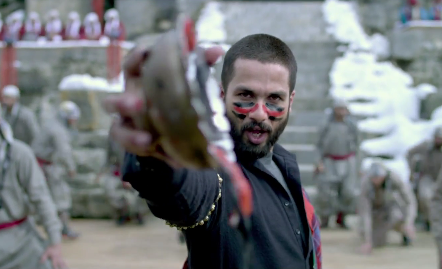
Shahid Kapoor, given his talent has always been scarcely used in good films. But as Shahid delivers these above mentioned lines, you almost can see a reflection of Pankaj Kapoor, an actor within Shahid almost willing to break the shackles and explore himself. And he gets ample opportunities. If the monologue that he delivers at the crossroads does not make you stand up and applaud, the performance in Bismil surely will. There are so many instances in the film where you feel that Shahid’s choice of work in the initial stages of his career wronged him and his talent, because what you see in Haider is a performance consumed in so many shades and realms of life and yet brutally honest. He has performed with much maturity. KUDOS! Pankaj Kapoor surely would be a proud father.


Vishal Bhardwaj’s third adaption of the Bard’s tragic trilogy is probably also his most self indulgent work but it never gets in the way of his story telling. One has to praise Vishal Bhardwaj for the manner in which he has adapted Hamlet. Never for once does it appear that something is amiss. Everything is served just in the right proportions and what is fantastic about Haider is that it terrifies you with its content and yet never lets you go out from the essence of the film.  
Not only has Bhardwaj masterfully narrated the story but also has prepared an absolutely outstanding music album which, if listened to properly, conveys the entire story.
For a detailed music review oh Haider, please visit the below mentioned link-

Overall Haider is a kind of cinematic experience that only Vishal Bhardwaj is capable of providing. It is disturbing yet evocative, grim yet hopeful, surreal yet realistic and disturbing yet engaging.

As the film ends, with Rekha Bhardwaj reciting Aaj Ke Naam (a poem by Faiz) there is invariably a sinking feeling that develops, a feeling which the mind fails to recognize, a feeling that states that yes, Kashmir is but a beautiful graveyard, a graveyard where thousands of dreams were buried whilst alive and yet it emerged out as the paradise as it once was. 

I would repeat, Bismil is one of the finest songs to have come out this year and its choreography and Shahid’s mind boggling performance only make it a rare masterpiece. Needless to say that Gulzar Sahab has worked magic with his words which very few are capable of.


It would be unfair to compare  the 3 adaptations by Bhardwaj and rank them as each one of them, apart from being radically different in their manner of adaptation, were also visibly different in the kind of cinematic experience they intended to provide.

HAIDER, to me is a film that rarely gets made. Rarity is what also happens to be Vishal Bhardwaj’s forte! Shakespeare would have been a proud man had he seen someone play around with his work with much finesse and command.

GULO ME RANG BHARE..BAAD-E-NO BAHAR CHALE
CHALE BHI AAO KI GULSHAN KA KAROBAAR CHALE.

**4.5 STARS**


Friday, 3 October 2014

BANG BANG - MOVIE REVIEW


Let this be said that the release of Bang Bang alongside Haider has seriously dampened the chances of a marvellous film to perform well. Mediocrity is here to prevail, yet again. And not very frequently is the word mediocre associated with a Hrithik Roshan film. But Bang Bang is a sheer waste of time and money. (Both on the account of the producer and the audience)

Flagging off as an official remake of the Hollywood Blockbuster Knight and Day, Bang Bang does not even match up or come close to be at least at par with the former, let alone be better.
The borefest that it turned out to be highlights the fact that the film makers CANNOT package something brilliantly whilst having a below average product at their disposal. Yes it might sell initially in the market but the recall value and the brand equity go for a toss.
The cinematography is extremely shabby. The shot takings are amateurish. Bang Bang has some of the most granulated and pixelated landscape shots of picturesque locations you'll ever see in a film! And for some reason or rhyme, there are far too many close up shots and they are pretty long shots as well.

Yes both the lead actors are stupendously good looking but it doesn’t mean the camera can stick on their faces for its own merry time. It felt claustrophobic after a point of time due to the tight shots (I was least interested in counting Katrina’s teeth; let alone counting Hrithik’s nasal hair) despite there being ample scope and opportunity to explore the wide angle shots which would have not only given a more relaxed look to the film but also a better canvas to lay the shots on.  

Bang Bang has some of the worst stock shots (majority of them being of a sleeping Katrina Kaif) that have been used for continuity purposes. Promoted as a slick action film, Bang Bang is excruciatingly long at a run time of over 155 minutes, and out of those 155+ minutes, more than 30 are spent just to set up a backdrop for the adapted screenplay to make the movie suitable for Indian audiences!

It is high time that our filmmakers realize that BHAI BHAI KA PYAR and stupidly arranged, Television-isqe family drama emotions no longer bring a lump in the throat. On a lighter note, Bang Bang looks like an updated IPhone model; it promises a lot but does not have genuinely much to offer from what is already available.
Time and again we have studied in our Marketing lectures that in-film advertising is a great option for the companies, it increases brand visibility et al. but from an audience point of view, it turns out to be the most horrible thing to bear. So in Bang Bang you have granulated stock shots of snow covered Shimla landscape where in a MACROMAN hoarding stands tall. Mountain Dew, Pizza Hut (Try the Pan Pizza sir, suggests the waiter), Jhonson Tiles etc etc.

If you are able to ignore all of the stuff mentioned above, steady yourself to witness Katrina Kaif’s rubbish performance. Playing the character of a regular bank employee (Katrina insists it’s a B-A-N-Q-U-E) who is forcibly made to realize that she has to find a lover because she doesn’t have one; her Dadi insists that she finds her true love, Modernization folks! She single handedly brings down the entire energy level that the film acquires rather rarely with much ease! So what if she looks beautiful, Bang Bang isn’t 150 minutes of a ramp walk!

Siddharth Anand (directed forgetful films like Ta Ra Rum Pum, Anjana-Anjani, Bachna-e-Haseeno) clearly lacks vision while adapting a film based on such a huge canvas. As a result, the characters (except Hrithik’s) have no graph. They just appear and disappear conveniently.
The scenes are not engaging. Sample the scene when an opening shot in Shimla appears, devoid of snow, brightly lit by sun rays and in the immediately followed outdoor scene, with about an hour into the movie’s timeline, Shimla is shown covered in snow! 
Another way in which the director could have judiciously used the run time was to develop on Hrithik’s character apart from that borrowed from Knight and Day. (Probably show how Roshan gets away with everything with exemplary ease!)
Another technical department which disallows the film from delivering the desired impact is the shabby editing. Scenes stretch, jump cuts are plenty and overall it is not a neatly packaged product.

Coming to the genuine good points about the film, the action sequences are just MIND BLOWING.
Hrithik probably performed lesser stunts in Krrish! Give it up for the wonderfully executed chase sequences and death defying stunts.
The film definitely manages to deliver Goosebumps while the action unfolds, be it the Seaplane scene, jumping from the rooftops in Shimla or riding a F1 car on the streets of Dubai. Such sequences are never seen before in BOLLYWOOD.
The action sequences serve as a real boost to the screenplay and lift it up from its shabbiness.

For any reason that this film can be watched is HRITHIK ROSHAN. He owns this film like a boss. He performs all the stunts like a pro, makes them look extremely believable and shines in the role of Rajveer Nanda.
He dances like a dream, looks like an artistic creation and makes jaw drop rather frequently. It would be fair to say that he sleepwalked through the film but delivered exactly what was sought from him. It is only by the end you realize that Bang Bang as a film does injustice to Roshan’s talent, who, visibly has given more than a 100% to this film. He is the only one who looks at ease with all the mess that’s been happening around and YES IT IS DIFFICULT to look away when he is performing.
The tribute to MJ was special.


Music helps this film a lot as the songs included are hummable and never dampen the pace of the film. Vishal-Shekhar deliver an album filled with their signature tunes and do a lot of good in terms of adding slick to the otherwise shabby film.

I had huge expectations from Bang Bang. They are shattered. My worst fear of Hrithik Roshan delving into the zone of the big-bad-budgeted commercial arena of films has come true. I hope it is a one off film.
Yes this film will earn crores of currency but that does not make it an inherently well made film. There are flaws, far too many. There are loopholes, glaringly evident. But then there is Hrithik Roshan, the single reason to bear 150 minutes of BANG BANG.


**2 STARS**


Friday, 26 September 2014

HAIDER - MUSIC REVIEW


Just when Bollywood music required some stability, grace and meaning, post some horrendous songs with a rapper promising to get Grammy and songs which definitely ensured that the NADEEM-SHRAVAN era was coming back, Vishal Bhardwaj delivers HAIDER. Needless to say that the expectations were soaring from this album and Bhardwaj has exceeded the expectations, like he does, always.
 There is something enigmatic about the combination of Vishal Bhardwaj and Gulzar Sahab, and it has been this way since they first collaborated for Maachis. Bhardwaj is back to complete his trilogy of the Shakespearean tragedies post Maqbool and Omkara; this time attempting to adapt one of the most difficult plays written by Shakespeare, Hamlet. What is surprising is the emphasis on the music that has been laid in this film. From adapting Faiz’s Ghazals to bringing out the best in Gulzar, from the rock influences to the Kashmiri Rubab, this album is a gem!

AAO NA - That Bhardwaj is no muck at Rock genre was evident years ago when he enthralled everyone with the soundtrack of Paanch. AAO NA is a brilliant composition, some thing which gives visibility to the album and to the film, and despite having elements of a chartbuster song; this is a very dark song.
The grave calls out to the dead to come and sleep as the world is dead is exactly what the song means. The rock influences in the song are superbly supported with Dadlani’s vocals as he croons along seamlessly. AAO NA is haunting and extremely catchy. Vishal Dadlani’s energetic vocals only make this song all the more irresistible.

BISMIL – It is this song that made me clap; clap for the brilliance of Gulzar’s command over words. Long ago in some forgotten era, songs were written to create imageries and situations in the minds of the listener which had to be interpreted to understand the subtlety of the wordplay. Unfortunately, explicit seems to be the norm of the day and hence a Desi Kalakar becomes a Superstar, meanwhile the genius of Bismil largely goes unnoticed. Sukhwinder Singh gives this song a very unique identity. Bismil is essentially the portrayal of the Mousetrap portion in the original play.
Depicitng the entire scenario with the story of two nightangles and an eagle, set in the backdrop of Kashmir valley, Bismil surely is an example of the power of words. It is the usage of Personification at its very best. Bhardwaj quietly lets the words weave their magic as he perfectly sets up the composition complete with Rubab’s Sarangi’s and Ektara’s.


KHUL KABHI TOH – Arijit Singh is an extremely gifted singer. Khul Kabhi Toh makes him utilise his wonderful gift of making difficult songs sound ridiculously simple. This one isn’t the quintessential Bollywood romantic track but is a trademark VB romantic track and is not very difficult to identify that. The vocalist steals the show as Gulzar sits back and pens down prosaic verses and VB sets them all into a very tempting groove. The beauty of this song lies in the smartly composed music. The romace comes out literally as the song progresses.
 Bekaraan, Khamakha etc (all VB’s compositions) have been already where Khul Kabhi Toh tries to be, but with lines like-  jhuk ke jab jhumka me chum raha tha, der tak gulmohar jhum raha tha, you can hardly complain.  


EK AUR BISMIL – I could barely figure out the reason behind putting the original composition into Arabic beats and make it sound shabby. It may also be primarily because of the fact that the focus here shifts from the words to the beats and hence it irked me as a listener. In all probabilities, this song will not be included in the film and will only be used for promotion purposes and that is good enough.

JHELUM – Vishal Bhardwaj showcases his skills as a singer with Jhelum, a track which talks about the pathos and sorrows where Jhelum’s struggle to find the shore serves as a metaphor for the protagonist’s search for a goal and shelter. This one is a short track but conveys what it intended to.

DO JAHAAN – Suresh Wadkar sings this track along with Shraddha Kapoor who sings certain Kashmiri folk portions in this song. This is probably the weakest composition in the entire album with Wadkar’s vocals turning out to be the only saving grace. The song goes off beat many a times and causes more distraction rather than indulgence which otherwise VB is extremely capable of with his compositions.

AAJ KE NAAM - This is not by any means a full blown track but a recitation of Faiz Abul Faiz’s masterfully written poem by Vishal Bhardwaj’s favourite, Rekha Bhardwaj. I sincerely urge everyone to search the symbolic meaning of this particular song for the Urdu used will significantly be incomprehensible for many of the listeners. Having read Faiz’s work while I grew up, this one connected instantly, more so because of the way Rekha Bhardwaj has recited it.
Rarely do you find a film maker and a music director willing to adapt and resurrect such beautiful pieces of literature for the coming generation.
Un haseenao ke naam, jinki aakho ke gul, chilmano aur dareecho ki belo pe, bekaar khil khil ke murjha gaye hai.
Faiz dedicated this poem to the undying spirit of women by portraying various life situations in the lifetime of women.

GULON ME RANG BHARE – When Mehdi Hassan Sahab lent his voice to the mesmerizing words of Faiz, magic was born in the form an evergreen ghazal. This probably was the 1st ghazal that I ever listened to. Jagjit Singh entered a bit late into my playlist. Excited as I was to listen to one of my all time favourite ghazal being re-rendered by Arijit Singh, I pressed the play button and trust me it has been on the loop. Playing continuously for over 3 days now, Arijit Singh holds onto his own skill sets and beautifully recreates the magic that once was created when Mehdi Sahab had the mic at his disposal.
But the person who deserves the applause is Mr. Vishal Bhardwaj. I have not seen anyone adapting a classic and turning it into another classic. What remains to be seen is how he has used Faiz’z work in a Shakespearean play.

Haider as a music album is a gem in itself. The lyrics tell a story, the music complements it and the singing puts out the emotion which the lyricist had in mind while penning the songs. 
In an era where the standards have literally been demolished as to what can qualify as music, VB and Gulzar Shab come across to reassure the faith in music. The chartbuster list would not boast of Haider’s songs but the listeners who are willing to invest some time to listen to some genuinely creative efforts, Haider’s playlist would be something to boast about.

For some music is a part of life, for some, a way of life.


**4.5 STARS**

Wednesday, 10 September 2014

THE DIRTY PICTURE -MOVIE REVIEW


A director fresh from the success of his last movie, a writer who garnered accolades for his screenplay and dialogues in his last movie, an actress who won a Filmfare for her last movie and a sensational storyline.
Looks like a deadly combo!
But the final product though, is not as good and racy as it looks in the promos and the teasers.

The good thing about the movie is its bare-it-all approach.

Among the other things about this movie, "sex" has been used as a theme but at the same time the mature handling of the theme has kept it away from going down the vulgar lane!

The movie looses the grip just before the intermission and towards the end (it even tests your patience in certain scenes) and that is probably the only fault in this movie Due to this the movie seems a bit stretched.

The movie fails to live up to the huge expectations but it does come close!

There are those OOH-LAA-LAA moments! The dialogues are sleazy at places and are very smartly written. One couldn't help but smirk and lough out loud at some witty one-liners.


Screenplay is not as consistent as it should be for a biopic. It is racy and slow at the same time! Had the screenplay been more powerful this movie could have been the best movie of this year!

VIDYA BALAN-ohh yess! She brings enough oomph and aahhs to the character she plays! What a superb actress! She’s not shy of showing her tummy when the other's are running behind size-zero!
She is "THE DIRTY PICTURE"!! And yeah she's going to get all the awards this time too! No words about her acting. No one could have done as much justice to Silk Smitha's role as she has done Her portrayal of the lonely girl hungry for love and attention is just fantastic. *salutes*

Emraan Hashmi does a good job but there is a monotonous string attached to his acting.

Naseeruddin Shah was a tad disappointing.
Tushhar hardly had anything to do.

Music is strictly ok. ooh-la-la has become a chartbuster. Ishq Sufiyana is hummable.

Direction is good and honest! If only Milan Lutharia could have done a little more justice to the screenplay, this movie would have become a modern day classic.

Enough said. This movie is an out and out Vidya Balan's movie and she delivers her sleaziest and sexiest best!
This movie is worth your time and money.

Go enjoy the ooh-laa-laa moments.


**3.5stars**